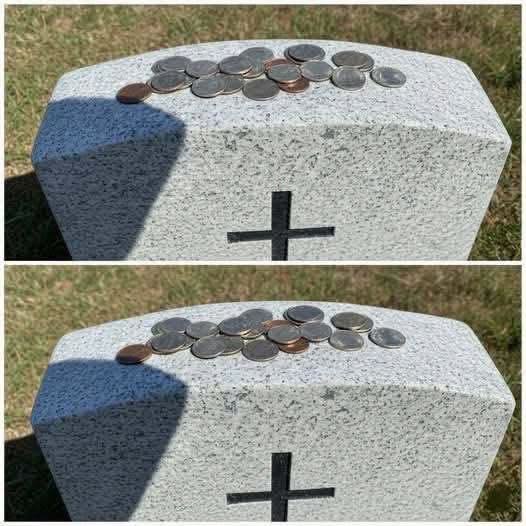
At first glance, a few coins placed on a gravestone may seem like a minor or accidental detail, easily overlooked among flowers, flags, or engraved stones. However, in many United States military cemeteries, these coins carry a deeply meaningful tradition that is understood within veteran communities. Far from being random objects, they represent intentional acts of remembrance, respect, and silent communication.
These coins are most commonly found in cemeteries where fallen service members are buried, including soldiers, marines, sailors, and airmen who served in the armed forces. Visitors who leave them are not simply placing spare change on a grave; they are participating in a symbolic ritual that expresses honor without the need for words. Each coin becomes a message of memory and recognitio
The tradition is widely associated with military culture in the United States and has developed into a quiet but powerful form of tribute. It reflects values such as loyalty, sacrifice, and brotherhood among those who have served. While it is not an official military requirement, it is widely respected and understood among veterans and their families.
Historically, the idea of leaving coins with the dead dates back thousands of years. In ancient Greek mythology, it was believed that the deceased had to pay Charon, the ferryman, to cross the river Styx into the afterlife. A coin was placed with the body to ensure safe passage. Similar traditions existed in ancient Roman and Egyptian cultures, where offerings were left to support or protect the deceased in the afterlife.
Over time, these symbolic practices evolved into modern cultural gestures of remembrance. While the beliefs behind them have changed, the core idea remains consistent: small objects can carry deep emotional meaning and serve as a bridge between the living and the dead.
In modern American military tradition, the coin practice became more widely recognized during and after the Vietnam War era. Veterans returning from service often experienced difficulty expressing grief or reconnecting with fallen comrades. In response, leaving coins at graves became a silent but powerful way to acknowledge shared experiences and loss.
Each type of coin carries a different meaning within this tradition. A penny is the simplest form of respect. It indicates that someone visited the grave and took a moment to honor the fallen service member. It is a quiet gesture of remembrance and acknowledgment
A nickel represents a deeper connection. It signifies that the visitor trained alongside the deceased, sharing formative experiences, discipline, and preparation during military service. This coin reflects bonds formed during the earliest stages of a soldier’s journey.
A dime carries even greater significance. It shows that the visitor served directly with the deceased in active duty. This may include shared missions, deployments, or combat situations where trust and reliance on one another were essential for survival.
A quarter is considered the most meaningful coin in this tradition. It symbolizes that the visitor was present when the service member passed away. It reflects firsthand witness to sacrifice and is often left as a powerful sign of respect, remembrance, and emotional connection.
These meanings are not formally regulated but are widely understood within military communities. They help transform simple objects into a structured language of remembrance that requires no spoken explanation among those familiar with the tradition.